Writing · Tooling
How I read 14 SEO and AI sources in 2 minutes a day
A scheduled job reads fourteen SEO, paid and AI sources every morning, sends a two-minute summary to Telegram, and stays silent when nothing happened.
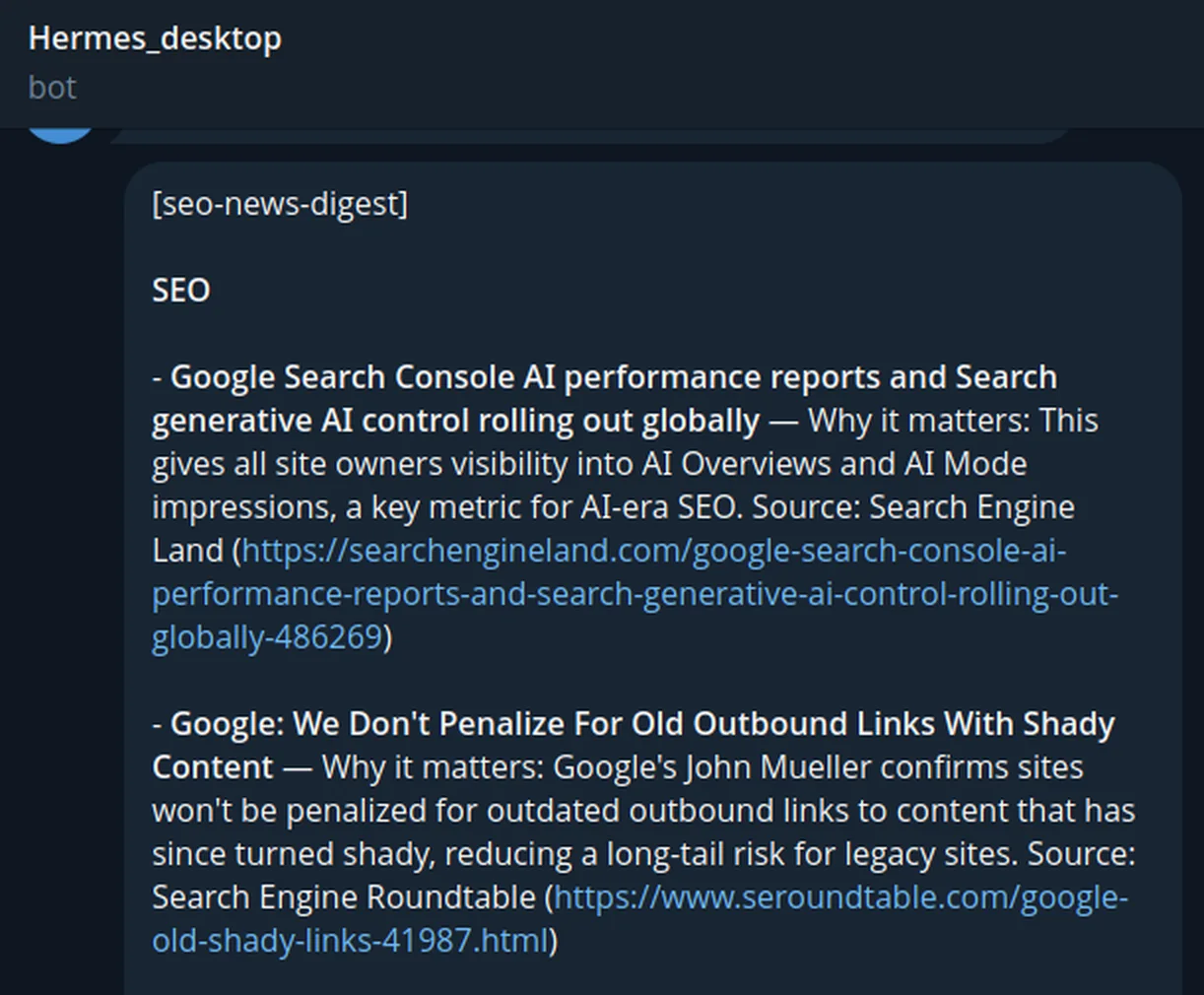
Search moves fast in three directions at once. Google changes ranking and reporting, Google Ads changes underneath the people spending money in it, and the AI answer engines are changing what a search result is. Anyone doing this work has to keep up with all three, and the honest version of keeping up is reading a dozen industry sites every day.
That was costing me the first hour of most mornings, so I built something to do it for me.
At 07:30 every day, a scheduled job reads fourteen industry sources, works out what is genuinely new, and sends me a short summary on Telegram. It is grouped under three headings: SEO, Google Ads and AI search. Each item is one line on what happened, one or two sentences on why it matters, and a link to the source.
It takes about two minutes to read.
What it reads
Fourteen sources, chosen so that each of the three areas is covered by the places that break news in it rather than the places that repackage it.
- SEO: Google Search Central, the Google Search Status dashboard, Search Engine Land, Search Engine Roundtable, Search Engine Journal, Ahrefs and Detailed.
- Google Ads: the Google Ads and Commerce blog, plus the paid search sections of Search Engine Land and Search Engine Journal.
- AI search: OpenAI, Anthropic, Google Gemini and Microsoft Bing, taken from the companies themselves rather than from coverage of them.
Google’s own Search Status dashboard is in there deliberately. It only publishes when there is an active ranking update or an outage, so anything from it is worth reading immediately.
It only links to pages it actually read
This is the part that makes the summary safe to act on.
The tool fetches every article itself, in code, before any AI is involved. The language model is then handed the text that was already retrieved. It has no internet access and no ability to go looking for anything, so it cannot find a link, and it cannot invent one and pass it off as found.
Then everything it writes is checked on the way back out. Every link in the summary is compared against the list of pages that were genuinely fetched that morning, and any line quoting a link that is not on that list is thrown away before the message is sent.
The reason for being that strict is simple. A summary that is right most mornings and confidently wrong occasionally is worse than no summary, because I would end up repeating something to a client that was never published. I would rather lose the occasional good line than send one bad one.
Nothing arrives on a quiet day
Some days there is no news worth an interruption. On those days the tool sends nothing at all.
That was a deliberate decision. A report that arrives every single morning without fail teaches you to stop opening it, because most mornings it is filler and you notice that before you notice anything useful. One that only shows up when there is something in it stays worth reading. If there is no message, it means nothing happened.
Failures are handled separately and loudly. If a source is unreachable or the summary cannot be generated, I get an error message instead, so silence never hides a broken job.
Sorted by topic, not by publisher
Each source is filed under the area it mostly writes about, which is accurate most of the time and wrong exactly where it matters.
Search Engine Roundtable is a search news site, so it sits under SEO. It also breaks a lot of Google Ads news, often first. Sorting by publisher would file those stories under SEO, where I would read them a day late or not at all.
So each story is sorted by what it is about, and the publisher is treated as a hint rather than the answer. On the first run after that change, five Google Ads stories came through and three of them were from sources filed under SEO.
What it does not cover
Perplexity is missing. Its blog blocks automated requests outright, and working around that is not worth it for one source when the other four AI companies publish openly.
There is also no cap on how much any one source can contribute to a single summary, so a high volume publisher can take up more of a morning’s digest than it deserves. That is why one otherwise good paid search source is not in the list: it publishes a hundred articles at a time and would crowd out everything else.
A second job runs on Monday mornings. Instead of a list, it reads the previous seven days back out and writes a short briefing on the themes, which is the view that is easier to lose when you are reading day to day.
None of this replaces judgement about what matters. It replaces the hour of reading that used to sit in front of that judgement.
Get in touch
Tell me about the role and I will come back to you. If you would rather not use a form, I am on LinkedIn.